
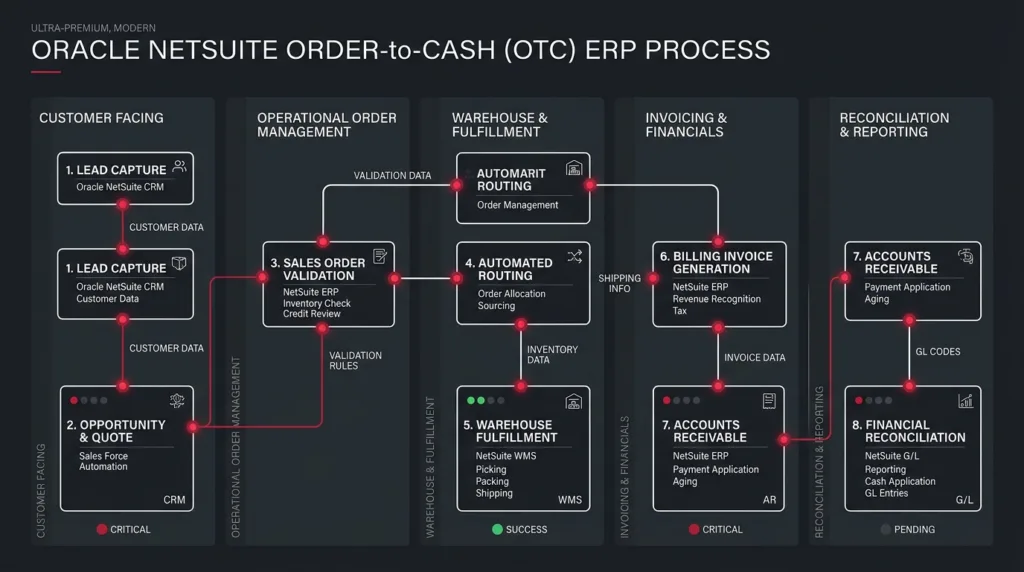
The NetSuite Order-to-Cash (O2C) process is the end-to-end business workflow that manages customer orders from initial sales engagement through order processing, fulfillment, invoicing, payment collection, and financial reconciliation. Also known as the OTC process, order-to-cash connects multiple departments, including sales, customer service, finance, accounting, warehouse operations, logistics, and executive management into an integrated operational continuum.
Oracle NetSuite provides a unified Cloud ERP environment in which customer records, sales transactions, multi-location inventory, warehouse fulfillment, accounts receivable, and general ledger reporting operate using shared, authoritative business data. The exact workflow depends on the company’s business model, enabled NetSuite features, accounting policies, and integration requirements.
For organizations selling physical products, configurable equipment, software, recurring subscriptions, or professional services, an effective NetSuite O2C implementation establishes a disciplined, traceable process from order acceptance to cash settlement. However, implementing order-to-cash is not simply a matter of creating a sales order and generating an invoice. Businesses must define the commercial rules, approval requirements, operational handoffs, accounting treatment, integration architecture, and exception-handling processes that determine how each transaction moves through the organization.
Motion Graphic 1.0: NetSuite Autonomous Order-to-Cash Event Fabric
Live Flow Telemetry • Sub-Second Ledger Event
Section 01
1. Understanding the Complete NetSuite O2C Lifecycle
A typical enterprise NetSuite order-to-cash workflow progresses through ten core architectural milestones:
- Lead and opportunity management: Capturing prospect interactions, sizing purchasing intent, and structuring commercial quotes upstream.
- Customer qualification and credit assessment: Validating credit limits, commercial terms, and subsidiary associations before contract execution.
- Quotation and sales order creation: Transforming negotiated proposals into binding transactional commitments within NetSuite.
- Order review and approval: Automating multi-tiered margin, discount, and export compliance validations prior to operational release.
- Inventory availability and fulfillment planning: Evaluating multi-location stock availability, reserving quantities, and generating drop-ship or special orders.
- Picking, packing, shipping, or service delivery: Executing warehouse workflows or professional services delivery milestones.
- Billing and invoice generation: Converting fulfilled quantities or milestone schedules into legally enforceable commercial invoices.
- Accounts receivable and payment collection: Managing dunning schedules, payment terms, dispute logging, and customer aging.
- Customer payment application and bank reconciliation: Ingesting remittance data, matching payments against invoices, and clearing GL transit accounts.
- Revenue recognition and financial reporting: Recognizing revenue in strict accordance with ASC 606 / IFRS 15 standards and closing financial accounting periods.
Depending on the business model, additional branches emerge: discrete manufacturing routing, subcontract procurement, subscription recurring billing schedules, RMA returns, credit memos, and multi-element revenue arrangements.
Section 02
2. Lead Management and Opportunity Qualification
Although lead management technically precedes the transactional order-to-cash boundary, it serves as the foundational data source for B2B enterprises operating structured pipelines. Incomplete or malformed lead data inevitably propagates downstream errors into logistics and finance.
Business Requirements
- Capture leads across marketing web forms, partner portals, and EDI feeds.
- Maintain relational hierarchies between contacts, parent corporations, and subsidiaries.
- Qualify prospects via BANT criteria (Budget, Authority, Need, Timeline).
- Track probability-weighted pipeline stages for financial forecasting.
- Enforce automated territory management and rep commission rules.
Relevant NetSuite Capabilities
- Native NetSuite CRM entities (Leads, Prospects, Opportunities).
- Integrated Lead-to-Customer conversion automation.
- Real-time sales forecasting linked to inventory replenishment models.
- Integration connectors for external CRMs (Salesforce, HubSpot) where NetSuite serves strictly as the financial and operational system of record.
Section 03
3. Customer Records, Credit Management, and Commercial Terms
In NetSuite, the Customer Record acts as the central relational nexus for sales, accounting, warehouse operations, and customer support. It governs multi-currency exposure, primary and secondary subsidiaries, localized tax determination schedules, billing and shipping address books, and credit risk profiles.
Credit and Risk Controls Architecture
For B2B businesses offering credit terms (e.g., Net 30, Net 60), the O2C workflow must programmatically evaluate financial exposure before releasing inventory:
Automated evaluation against open invoices, pending orders, and unbilled commitments.
Automatic order hold when invoices exceed configured aging thresholds (e.g., 45 days past due).
Two-key cryptographic approval routing allowing credit managers to override holds with full audit logging.
Should sales orders automatically enter a hard credit hold upon creation if aging limits are breached, or should the hold trigger downstream prior to warehouse picking? Documenting this boundary prevents warehouse labor wasted picking orders that finance cannot release.
Section 04
4. Quotation and Sales Order Management
The quotation-to-order phase transitions a commercial handshake into an immutable operational contract. In NetSuite, while an estimate/quote carries no financial impact, a Sales Order represents an operational commitment that commits inventory and establishes future revenue obligations without directly posting to the General Ledger.
| Validation Field | NetSuite ERP Behavior | Downstream Impact |
|---|---|---|
| Subsidiary & Currency | Locked to customer primary or secondary subsidiary | Enforces correct tax schedule, nexus, and multi-book accounting |
| Item Pricing & Price Level | Applies customer-specific contract pricing matrix | Prevents unauthorized rep discounting and margin erosion |
| Inventory Commitment | Allocates available quantity from designated warehouse location | Protects committed inventory from being hijacked by competing orders |
| Billing Schedule | Attaches milestone or recurring invoice plan | Governs when and how finance generates downstream invoices |
Section 05
5. Inventory Management and Availability Checks
Inventory availability represents the critical operational constraint in physical goods distribution. A sales order can be commercially validated and approved, yet completely unfulfillable if warehouse stock is exhausted, committed to emergency stock reserves, or stalled in inbound customs.
Calculates available-to-promise (ATP) across distributed warehouses, 3PL facilities, and retail hubs, routing orders dynamically to the optimal dispatch facility.
Mandatory enforcement of FIFO/FEFO rules, expiration date tracking, and compliance serialization for regulated pharmaceutical, food, or industrial components.
Triggers automated purchase orders (Special Order / Drop Ship) or assembly work orders when order quantity exceeds on-hand committed stock thresholds.
A distributor receives an order for 100 industrial pumps, but only 60 exist at the primary regional distribution center. NetSuite rules dictate whether the system executes a split shipment (dispatching 60 units immediately and backordering 40), initiates an inter-company inventory transfer from a secondary facility, or places the entire order on a temporary fulfillment hold.
Section 06
6. Order Fulfillment, Warehouse Operations, and Shipping
Once a sales order satisfies credit approval and inventory allocation criteria, it enters the warehouse execution pipeline. NetSuite’s Item Fulfillment transaction records the physical transition of goods out of inventory, relieving inventory asset accounts and posting to Cost of Goods Sold (COGS).
Motion Graphic 2.0: NetSuite Advanced Shipping Decoupled Architecture
Async Stream Processing
local_shipping
Item Fulfillment Transaction
receipt_long
Customer Invoice Transaction
Architectural Takeaway: Enabling NetSuite’s Advanced Shipping feature permanently decouples fulfillment from billing. Warehouses dispatch goods without waiting for billing clerks, and finance bills partial fulfillments without locking open line items.
Section 07
7. Billing, Invoicing, and Advanced Billing
Billing converts fulfilled deliverables into legally binding financial claims against customer accounts. In standard transactional flows, NetSuite generates an Invoice (for credit terms) or a Cash Sale (where immediate credit card or cash settlement occurs).
Invoice Controls & Governance
- Automated Duplicate Prevention: Unique PO enforcement blocking duplicate invoice generation.
- Posting Period Locking: Prevents invoices from backdating into locked accounting periods, protecting historical period-end closures.
- Consolidated Invoicing: Combines multiple weekly or monthly shipments into single consolidated customer statements.
- Tax Nexus Validation: Dynamic real-time calculation of local, state, and international sales tax or VAT.
SuiteBilling & Advanced Schedules
- Milestone Progress Billing: Automatic 30% upfront, 40% dispatch, 30% sign-off invoicing triggers.
- Subscription Management: Automated recurring usage, tier-based billing, and evergreen subscriptions via SuiteBilling.
- Proration & Mid-Cycle Co-Terming: Mathematical precision for mid-month license expansions or seat upgrades.
Section 08
8. Accounts Receivable and Payment Collections
Once an invoice posts to the General Ledger, the Accounts Receivable (AR) function monitors cash liquidity, enforces credit terms, and coordinates dunning workflows. Receivables efficiency directly dictates an enterprise’s Days Sales Outstanding (DSO) and working capital health.
| Collection Stage | Trigger Condition | Automated Action | Operational Owner |
|---|---|---|---|
| 1. Pre-Due Notice | 7 days before due date | Automated courtesy PDF statement & payment link | AR Automation Engine |
| 2. Grace Period | 1-14 days past due | Friendly reminder notice with remittance confirmation request | AR Specialist |
| 3. Dunning Escalation | 15-30 days past due | Formal dunning letter; copy routed to Account Executive | Collections Lead |
| 4. Credit Hold Trigger | 31+ days past due | System-wide order entry lock; warehouse picking halted | Finance Director |
Section 09
9. Payment Processing, Application, and Reconciliation
Depositing funds into an enterprise bank account does not conclude the O2C cycle. The payment must be ingested, validated, applied against specific outstanding receivables, and reconciled against bank statements with zero unapplied cash ambiguity.
Payment Methods & Ingestion
- Bank Wire / ACH: Automated ingestion of electronic remittance advices (BAI2, MT940, CAMT.053 format).
- Credit & Debit Gateways: Native SuitePayments processing (Stripe, CyberSource, MerchantE) with tokenized PCI compliance.
- Lockbox Banking Feeds: High-volume optical check scan matching directly to NetSuite invoice records.
Application & Exception Handling
- Short Payments & Deductions: Auto-generation of customer dispute claims for unauthorized freight or damage deductions.
- Multi-Invoice Remittances: Algorithmic distribution of lump-sum wire deposits across dozens of open bills.
- Foreign Exchange Variance: Automated calculation and posting of Realized FX Gain/Loss to GL.
Section 10
10. Revenue Recognition and Financial Accounting
Revenue recognition must never be conflated with billing. While an invoice represents a commercial demand for payment, revenue recognition is governed by legal accounting frameworks (ASC 606 / IFRS 15) dictating when performance obligations are fulfilled.
NetSuite Advanced Revenue Management (ARM)
NetSuite’s Advanced Revenue Management module automates complex revenue schedules, multi-element arrangements (bundles combining hardware, software licenses, implementation services, and maintenance), and fair-value amortization:
Revenue recognized point-in-time upon item fulfillment dispatch or customer receipt.
Revenue deferred upon invoice generation and recognized ratably over the 12-to-36 month service period.
Revenue triggered exclusively upon signed project deliverables and client sign-off acceptance.
Automated Standalone Selling Price (SSP) allocation across hardware, software, and warranty tiers.
Section 11
11. Returns, Refunds, and Credit Memos
An enterprise O2C architecture must handle reverse logistics with the exact same rigor as forward sales. Without disciplined controls, returned goods vanish into warehouse blind spots, inventory valuations distort, and credit memos create accounting reconciliation deficits.
- Return Authorization (RMA): Customer support initiates an RMA linked directly to the original sales order or invoice, verifying warranty and return eligibility.
- Item Receipt (Warehouse): The warehouse inspects physical goods upon arrival, scanning serial numbers and recording condition (Restock, Rework, Scrap, or Return to Vendor).
- Restocking Fee & Freight Adjustment: System automatically calculates re-stocking deductions based on contract terms.
- Credit Memo or Customer Refund: Finance approves a Credit Memo applied to open customer balances or issues an electronic gateway refund.
- GL Audit Trail: Inventory asset accounts replenish, COGS reverses, and Accounts Receivable adjusts automatically without orphan entries.
Section 12
12. Core NetSuite Modules That Support Order-to-Cash
NetSuite’s power lies in its relational database architecture where native ERP modules operate over a unified data model, eliminating point-to-point data batch delays:
| NetSuite Module / Capability | Core Function in O2C Pipeline | Key Relational Records Handled |
|---|---|---|
| CRM & Sales Force Automation | Upstream lead capture, opportunity stages, and quoting | Lead, Prospect, Opportunity, Estimate |
| Order Management | Commercial validation, discount approvals, status governance | Sales Order, Cash Sale, RMA |
| Multi-Location Inventory | Stock visibility, availability-to-promise, inventory reservation | Inventory Item, Assembly, Bin, Location |
| Warehouse Management (WMS) | Barcode wave picking, carton packing, shipping manifests | Wave, Pick Task, Item Fulfillment |
| Procurement & Purchasing | Automated purchase orders for backordered or drop-ship items | Purchase Order, Item Receipt |
| Financial Management & GL | Ledger posting, accounting period controls, audit trail | Journal Entry, GL Account, Subsidiary |
| Accounts Receivable (AR) | Invoicing, customer balance tracking, aging, and dunning | Invoice, Customer Payment, Credit Memo |
| Cash Management | Bank statement feeds, matching, and general ledger reconciliation | Bank Deposit, Bank Statement, Transit Account |
| SuiteTax / Tax Management | Automated jurisdiction tax determination and reporting | Tax Item, Tax Group, Nexus Definition |
| Advanced Revenue Management (ARM) | ASC 606 revenue scheduling, fair-value amortization | Revenue Plan, Revenue Arrangement |
| SuiteBilling | Complex subscription, usage, and evergreen recurring plans | Subscription, Price Book, Usage Record |
| SuiteAnalytics | Real-time KPI dashboards, saved searches, exception alerts | Workbook, Dataset, Saved Search |
Section 13
13. NetSuite Integrations Required for a Connected O2C Process
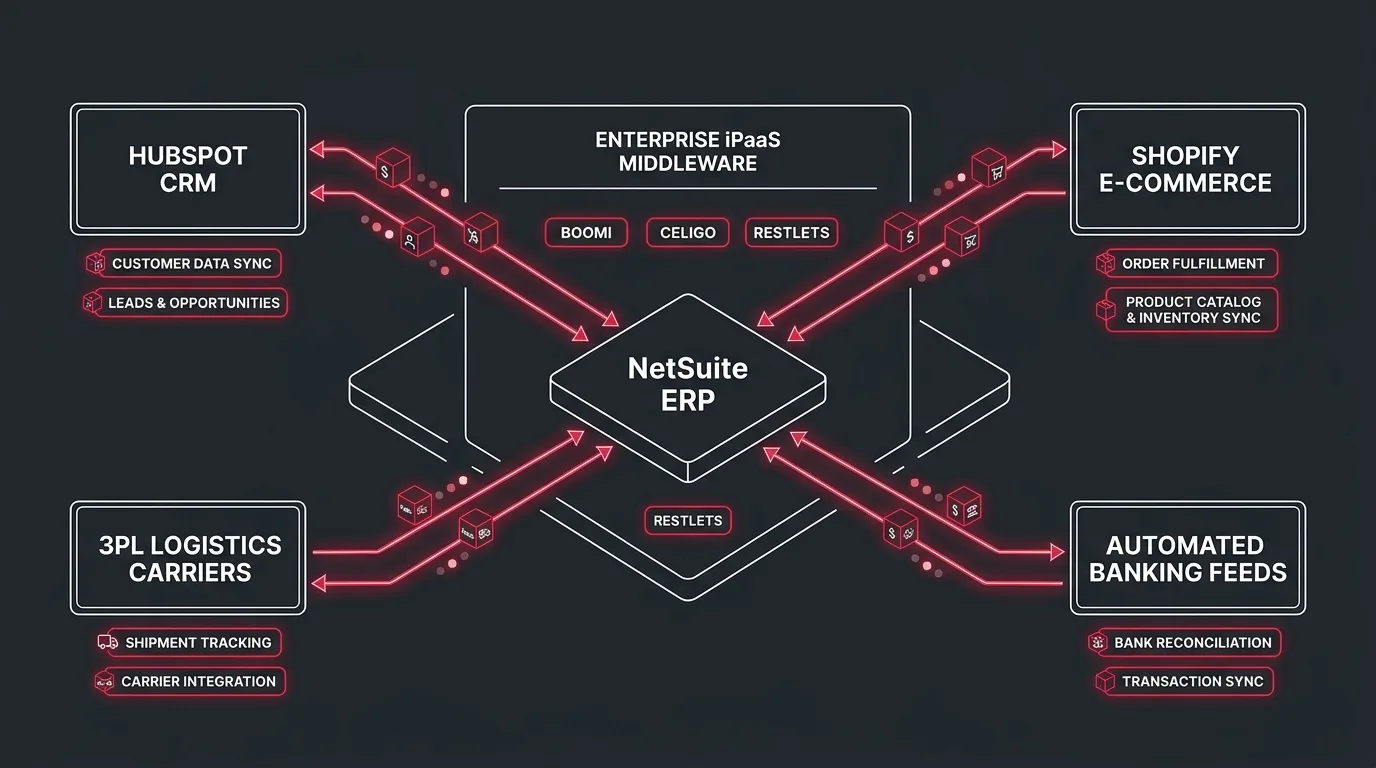
Enterprise organizations rarely operate NetSuite in isolation. Front-office marketing, digital commerce storefronts, warehouse robotics, and logistics carriers must integrate into NetSuite via a resilient integration middleware architecture.
CRM Integrations (HubSpot, Salesforce)
Bi-directional event synchronization ensures sales teams have complete visibility into ERP fulfillment and credit limits without requiring full ERP licenses. Opportunities marked Closed-Won generate Sales Orders via idempotent RESTlets, and NetSuite returns real-time fulfillment and invoice status back to the CRM timeline.
E-Commerce Integrations (Shopify, Magento, Custom Portals)
Real-time order ingestion, customer record normalization, and bi-directional inventory quantity pushes prevent out-of-stock digital cart checkouts. NetSuite acts as the master authority for product catalog metadata, pricing tiers, and available inventory.
Shipping & 3PL Integrations (FedEx, UPS, ShipStation, 3PL Central)
Automated generation of carrier shipping labels, bills of lading, and freight tracking push. Item fulfillment events update in real time with carton weights, dimensional data, and tracking URLs.
EDI & B2B Integrations (TrueCommerce, SPS Commerce, Cleo)
Automates ANSI X12 document exchange for large retail and enterprise accounts: EDI 850 (Purchase Order Ingestion) → EDI 855 (Order Acknowledgment) → EDI 856 (Advance Ship Notice) → EDI 810 (Sales Invoice).
Middleware & Automation Protocols (Boomi, Celigo, Workato, n8n)
Leveraging modern middleware with SuiteTalk REST/SOAP APIs, SuiteScript RESTlets, dead-letter queues (DLQ), and token-bucket concurrency management guarantees sub-second synchronization and zero lost transactions during volume surges.
Section 14
14. Designing the NetSuite Order-to-Cash Pipeline
An operational O2C pipeline visualizes the exact operational location of every order, identifies bottlenecks, and enforces clear criteria for transitioning between business stages:
| Stage | Responsible Team | Mandatory Exit Criteria |
|---|---|---|
| 1. Order Received | Sales Operations | All customer, line item, and commercial details captured. |
| 2. Validation Pending | Sales Operations | Customer tax nexus, pricing tiers, and delivery terms validated. |
| 3. Approval Pending | Sales Management / Finance | Nonstandard discounts and margin thresholds approved. |
| 4. Credit Review | Credit & Collections | Credit check cleared or formal exception override approved. |
| 5. Ready for Fulfillment | Order Management | Order released to warehouse execution queue. |
| 6. Inventory / Procurement Review | Supply Chain | Stock committed or purchase order issued for shortfall. |
| 7. Fulfillment in Progress | Warehouse Operations | Items picked, packed, and packed into cartons. |
| 8. Partially Fulfilled | Warehouse / Order Mgmt | Partial shipment manifested; remainder placed on backorder. |
| 9. Ready for Billing | Billing Operations | Fulfillment confirmed or milestone deliverable completed. |
| 10. Invoice Issued | Accounts Receivable | Invoice posted to GL and transmitted to customer. |
| 11. Payment Pending | Accounts Receivable | Receivable tracked against commercial due date. |
| 12. Overdue / Disputed | Collections & Account Exec | Resolution plan recorded or escalated to credit hold. |
| 13. Payment Applied | Cash Accounting | Remittance reconciled and matched against customer invoices. |
| 14. Reconciled and Closed | Finance Leadership | Bank deposit matched, revenue recognized, and order closed. |
Section 15
15. Operational Engagement: Who Owns Each Stage?
Technology configuration alone cannot guarantee operational success. Cross-functional teams must have unequivocal clarity regarding role-based accountabilities and escalation paths:
Responsible for initial commercial accuracy, accurate customer documentation, and assisting collections when strategic accounts breach payment terms.
Validates data integrity, oversees approval workflows, monitors inventory reservation conflicts, and ensures order release velocity.
Establishes credit underwriting standards, reviews financial hold exceptions, manages revenue recognition compliance, and closes accounting periods.
Governs wave picking, carton packing, carrier compliance labeling, and immediate fulfillment status synchronization.
Issues accurate invoices, delivers customer statements, manages automated dunning schedules, and resolves payment allocation variances.
Maintains API endpoints, monitors dead-letter queues, oversees SuiteScript performance, and governs system security protocols.
Section 16
16. NetSuite O2C KPIs and Management Reporting
Enterprise leadership requires actionable executive dashboards that synthesize financial outcomes with granular operational efficiency metrics:
Elapsed time from customer order submission to verified warehouse shipment delivery.
Average collection time calculated as: (Total AR / Total Credit Sales) × Number of Days.
Percentage of shipments delivered meeting committed customer dates with zero missing line items.
Percentage of invoices issued that never require subsequent credit memo adjustments or corrections.
Monetary sum of customer payments sitting in unapplied limbo awaiting remittance resolution.
Rate of payload failures across CRM, e-commerce, and 3PL endpoints per thousand transactions.
Section 17
17. Common NetSuite O2C Implementation Challenges
Understanding the failure modes of complex ERP rollouts allows organizations to proactively engineer defensive safeguards:
Duplicate customer records, fragmented SKU conventions, and obsolete shipping addresses cause downstream invoice rejections. Remedy: Implement automated entity deduplication and master data governance before migration.
Orders stall in approval queues because thresholds lack automated routing delegates. Remedy: Design hierarchical SuiteFlow rules with automatic escalation and mobile-ready one-click approval buttons.
Sales representatives commit delivery dates based on on-hand stock without accounting for pending allocations. Remedy: Configure real-time available-to-promise (ATP) rules and restrict order confirmation to committed inventory.
Invoices diverge from customer purchase orders due to tax calculation discrepancies. Remedy: Deploy certified tax engines (Avalara / Vertex) integrated directly at both quote and invoice levels.
Middleware failures drop orders silently when API limits or schema updates occur. Remedy: Enforce dead-letter queue (DLQ) alerts and automated exponential retry logic across all API connectors.
Section 18
18. NetSuite Order-to-Cash Implementation Best Practices
Successful enterprise deployments adhere to an engineering-driven, step-by-step methodology:
Map current-state workflows, document edge-case exceptions, and catalog all legacy commercial rules.
Establish exact system of record boundaries between CRM, NetSuite ERP, 3PL platforms, and banks.
Differentiate native NetSuite capabilities from requirements demanding SuiteBilling, ARM, or WMS add-ons.
Implement idempotent webhook handlers, rate-limiting queues, and transactional audit logs.
Automate discount routing, credit limits, billing triggers, and automated notification alerts.
Scrub legacy customer entities, historical open orders, and uncollected invoice balances against trial balances.
Execute full scenario tests: split shipments, credit hold overrides, returns, disputed payments, and month-end closes.
Deliver tailored, practical training documentation for warehouse clerks, billing accountants, and sales engineers.
Monitor integration dead-letter queues, track first-pass invoice accuracy, and optimize database saved searches.
Summary
Conclusion
The NetSuite order-to-cash process connects commercial activity with multi-location inventory, warehouse fulfillment, billing, collections, and financial reporting. Its ultimate effectiveness depends on more than software capabilities: it mandates disciplined business policies, immaculate master data, appropriate module configuration, unambiguous operational ownership, and integrations that maintain total data integrity.
By architecting O2C as an end-to-end operational operating model rather than disconnected departmental silos, organizations accelerate order cycle times, eliminate manual rekeying, recover working capital, and establish rock-solid accounting controls from customer commitment to bank settlement.
Enterprise ERP & Integration Advisory
How iDesk Media Accelerates Your NetSuite Architecture
iDesk Media helps growing and enterprise businesses connect CRM, NetSuite ERP, e-commerce storefronts, and warehouse systems through integration consulting, custom SuiteScript development, API middleware architecture, and automated workflow engineering.
Whether your organization is embarking on a fresh NetSuite implementation, resolving bi-directional order sync desynchronization, integrating HubSpot or Salesforce, or automating complex billing schedules, our senior systems engineers deliver production-verified solutions.
Knowledge Base
Frequently Asked Questions
What is the NetSuite order-to-cash process?
expand_more
The NetSuite order-to-cash (O2C) process is the complete end-to-end workflow connecting customer demand with order capture, inventory reservation, warehouse fulfillment, invoicing, accounts receivable, and cash reconciliation within Oracle NetSuite.
Which NetSuite modules are used for order-to-cash?
expand_more
Core capabilities include CRM, Order Management, Multi-Location Inventory, Warehouse Management (WMS), Financial Management (GL), Accounts Receivable, Cash Management, Tax Management, and Advanced Revenue Management (ARM), alongside SuiteBilling where subscription or usage billing models apply.
Can NetSuite automate the order-to-cash process?
expand_more
Yes. NetSuite automates substantial portions of the O2C cycle using native SuiteFlow workflows, event-driven SuiteScript, automated dunning modules, and asynchronous integration middleware. Routine orders meeting approval criteria flow straight through from order entry to pick-and-pack without human intervention.
Can NetSuite integrate with HubSpot or Salesforce?
expand_more
Yes. NetSuite integrates seamlessly with HubSpot and Salesforce via enterprise iPaaS platforms (Boomi, Celigo, Workato) or custom RESTlets. The architecture defines CRM as the master for customer discovery and deals, while NetSuite remains authoritative for credit limits, inventory quantities, and invoices.
How does NetSuite handle order fulfillment and invoicing?
expand_more
NetSuite utilizes Sales Orders to govern the transaction. Enabling the Advanced Shipping feature separates the fulfillment process (Item Fulfillment) from the billing event (Invoice/Cash Sale), allowing warehouse dispatches and billing schedules to operate independently.
What is the difference between order-to-cash and quote-to-cash?
expand_more
Order-to-cash begins upon formal customer order acceptance and concludes with payment reconciliation. Quote-to-cash (QTC) encompasses an expanded upstream lifecycle including CPQ (Configure, Price, Quote), contract drafting, commercial negotiation, and legal signature before order release.
How can an enterprise improve its NetSuite O2C cycle time?
expand_more
Key improvements include standardizing customer master data, automating discount approval hierarchies, deploying barcode wave picking, separating fulfillment from billing via Advanced Shipping, automating bank statement reconciliation, and establishing active queue monitoring.
Further Reading & Authoritative References
- Oracle NetSuite Official Resource: What Is Order-to-Cash (O2C)?
- Oracle NetSuite Cloud Help Documentation: Invoicing Sales Orders in NetSuite
- Oracle NetSuite Cloud Help Documentation: Creating Invoices or Cash Sales from Sales Orders
- iDesk Media Technical Insights: Connecting ERP and CRM Systems: Solving Bi-Directional Order-to-Cash Desync
- iDesk Media Architecture Guide: API Integration vs Middleware: What Growing Businesses Need to Know