
B2B Commercial Systems Audit & Digital Experience Strategy
A business website is often the first place potential customers go when evaluating a technology partner. They arrive with questions, compare different providers, explore solutions, and attempt to determine whether a company understands their challenges.
Yet many B2B technology websites focus heavily on describing services while overlooking the information customers actually need to make purchasing decisions.
For a company offering CRM consulting, ERP integration, workflow automation, and digital transformation services, this creates a significant opportunity. A website should not simply explain what the company does. It should help prospective customers recognize their problems, understand possible solutions, evaluate expertise, and take the next step with confidence.
This requires evaluating a website through four interconnected dimensions: content completeness, usability, lead-generation capability, and alignment with customer requirements.
Systems Evaluation
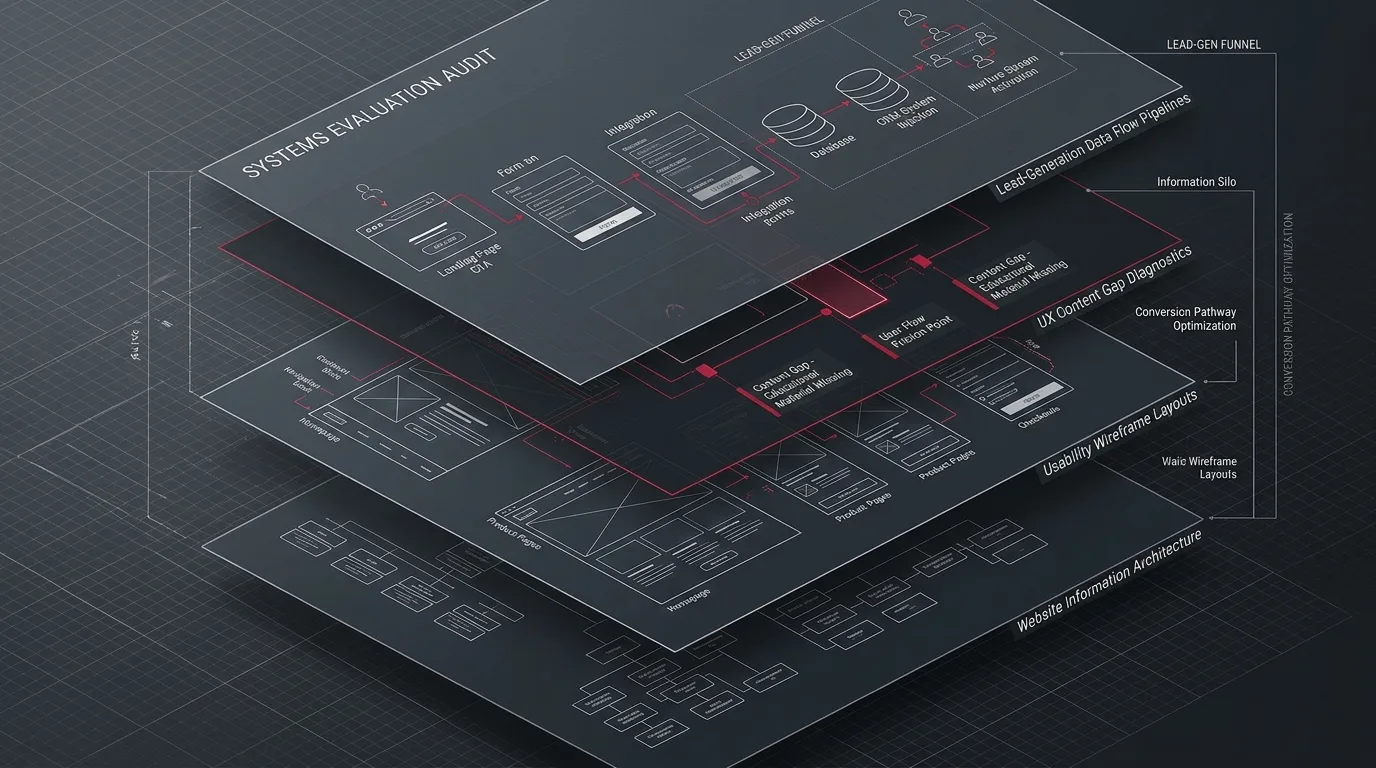
1. Content Gaps: Are You Answering the Questions Customers Actually Ask?
One of the most common challenges on B2B technology websites is the gap between what a service provider wants to communicate and what a potential customer needs to know.
A page describing CRM integration might explain that the company connects different systems using APIs and middleware. However, a prospective customer may be looking for answers to much more practical questions:
If the website doesn’t address these questions, visitors must contact the company before they can even determine whether it is a suitable partner. That additional effort can discourage qualified prospects from continuing their evaluation.
The Five Content Categories Most B2B Technology Websites Need
| Content Category | What Customers Want to Understand |
|---|---|
|
Problem-oriented content |
What is causing the issue, and how can it be resolved? |
|
Solution-oriented content |
Which approach or technology is appropriate for our situation? |
|
Implementation content |
What will the project involve, and what are the risks? |
|
Decision-support content |
What are the costs, alternatives, trade-offs, and expected outcomes? |
|
Trust-building content |
Has the provider solved similar problems, and can we rely on its expertise? |
A website that covers all five categories can support a prospective customer throughout the buying journey rather than focusing exclusively on initial awareness.
From Service Descriptions to Useful Knowledge
Consider the difference between these two approaches:
“We provide HubSpot and NetSuite integration services to streamline business processes and improve operational efficiency.”
Lacks context, fails to address operational pain points, and sounds identical to every competitor.
“Are your sales representatives creating orders in HubSpot that your finance team must manually re-enter into NetSuite? A properly designed integration can synchronize approved deals, customer information, products, and order details while maintaining transaction references and validation rules.”
Identifies a recognizable operational breakdown, illustrates implications, and frames a practical engineering solution.
The second example identifies a recognizable operational problem, explains its implications, and introduces a potential solution. This is the kind of content that attracts visitors who are actively evaluating a solution.
Maturity Spectrum
2. Website Usability: Can Visitors Find What They Need Without Assistance?
Website usability is not limited to loading speed, mobile responsiveness, or visual design. It also includes how effectively the website communicates its structure, guides visitors, and reduces the effort required to find relevant information.
A technically impressive website can still create friction if its navigation is unclear or its service categories don’t reflect how customers think.
Navigation Audit
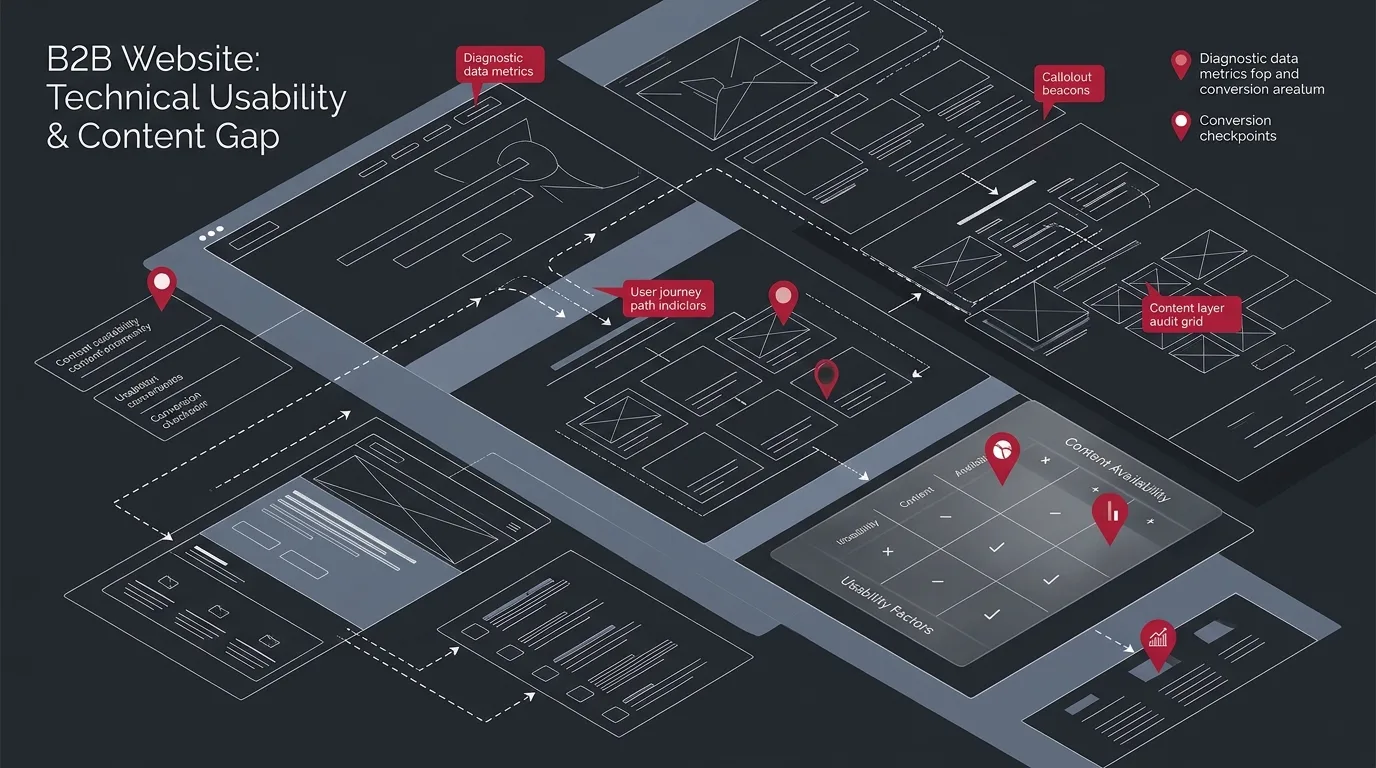
Organize Services Around Customer Intent
Technology companies often organize their websites entirely around internal service categories:
API Development
Middleware Integration
Workflow Automation
ERP Implementation
These categories are useful, but they may not reflect the language used by prospective customers. A business searching for a solution might instead think in terms of:
- Connecting Salesforce with NetSuite.
- Automating lead-to-cash processes.
- Migrating from an existing CRM without downtime.
- Eliminating manual spreadsheet data entry between departments.
- Improving visibility across sales and finance ledgers.
- Fixing an unreliable CRM–ERP integration.
An effective website should accommodate both perspectives. A visitor should be able to discover services by technology, by business problem, and by integration use case.
Essential Usability Considerations
| Usability Area | What to Evaluate |
|---|---|
| Navigation | Are services, platforms, industries, and solutions easy to locate within two clicks? |
| Page hierarchy | Can visitors understand the primary purpose of a page within five seconds? |
| Readability | Is technical content structured into scannable sections with informative headings, callouts, and tables? |
| Mobile experience | Can decision-makers comfortably review architectural diagrams and submit consultation requests on mobile devices? |
| Internal linking | Can users move naturally from an educational article directly to an applicable platform solution? |
| Calls to action | Are next steps clear, contextual, easy to access, and aligned with visitor intent? |
| Accessibility | Are color contrasts, keyboard focus states, form field labels, and SVG elements WCAG 2.2 compliant? |
| Performance | Do pages load quickly with minimal Cumulative Layout Shift (CLS) and no intrusive JavaScript blocking? |
The Importance of Contextual Navigation
Imagine a visitor reading an article about synchronizing HubSpot and QuickBooks Online. At the end of the article, directing the visitor to a generic homepage creates unnecessary friction.
A better experience offers relevant, intent-driven next steps:
The navigation should reflect what the visitor is already interested in rather than requiring them to restart their journey.
Routing Blueprint
3. Lead Generation: Is the Website Converting Interest Into Opportunities?
Website traffic is not the same as business growth.
A visitor might read three articles, explore two integration pages, and leave without contacting the company. That does not necessarily mean the content failed. The visitor may not yet be ready to purchase.
The real question is whether the website provides an appropriate next step for visitors at different stages of their buying journey.
Understand the Different Types of Visitors
| Visitor Type | Typical Requirement | Suitable Conversion Opportunity |
|---|---|---|
| Researching a problem | Understand root causes and evaluate potential fixes | Educational guide or architectural checklist |
| Comparing technologies | Evaluate approaches, trade-offs, and platform suitability | Comparison article or platform solution page |
| Evaluating providers | Assess technical track record, methodology, and credibility | Case study, topology diagram, or technical assessment |
| Ready to purchase | Discuss requirements, scoping, timeline, and pricing | Direct meeting booking or architectural inquiry |
| Existing customer | Get technical assistance or scope system expansion | Support portal or retainer service request |
Treating all five groups as identical and presenting the same generic “Contact Us” button everywhere severely constrains conversion performance.
Funnel Architecture
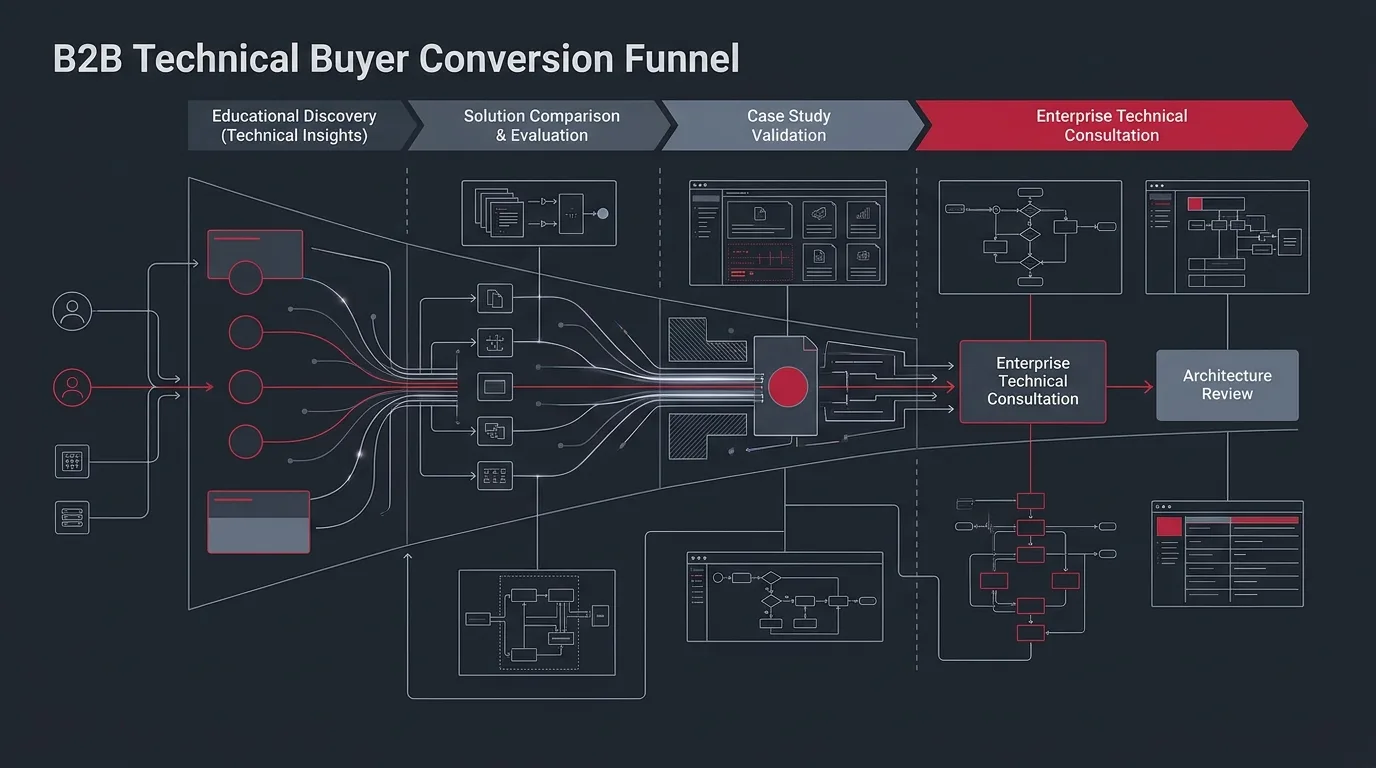
Build a Conversion Journey Around Intent
An effective B2B conversion journey follows a calibrated intent pathway:
→
Relevant solution page
→
Technical case study
→
Architecture consultation
Not every visitor needs to follow this sequence. A prospect who already knows what they need should be able to book a meeting directly. The website should provide multiple entry points while maintaining a consistent conversion strategy.
Calls to Action Should Match the Page
| Page Type | Recommended Call to Action |
|---|---|
| Educational article | Discuss how this applies to your business |
| Integration solution | Review your integration requirements |
| CRM consulting | Evaluate your CRM architecture |
| Case study | Discuss a similar implementation |
| Technical service page | Request a technical assessment |
| Homepage | Book a discovery meeting |
For iDesk Media, a central meeting-booking page serves as the primary conversion destination, while individual pages deploy contextual messaging to maintain relevance.
Measure What Matters
A website’s lead-generation performance should be evaluated through more than visitor counts. Important metrics include:
Commercial Search Traffic
Organic search visits specifically to commercial integration and service pages.
Meeting Bookings
Qualified consultation bookings generated directly from organic search and insights.
Content-Assisted Deals
Articles and case studies visited by prospects prior to signing engagement contracts.
A page with fewer visitors but more qualified consultation requests contributes significantly more business value than a popular but generic informational article.
Conversion Matrix
4. Potential Customer Requirements: What Are Prospects Actually Buying?
A company rarely purchases CRM consulting, ERP integration, or automation simply because it wants another technology implementation.
It usually purchases these services to address an operational problem, reduce business risk, improve employee productivity, or support company expansion. Understanding this distinction is essential for content strategy.
01
Requirement 1: Visibility across business operations
Companies operating multiple systems often struggle to obtain a unified view of their customers, orders, revenue, and operational activities. A sales team may use a CRM, finance may operate in an ERP, and customer service may rely on a separate support platform.
The underlying requirement is not simply integration. It is consistent, accessible, and reliable business information.
- Connecting CRM and ERP data for executive and board reporting.
- Building a unified customer master data architecture (Customer 360).
- Resolving inconsistent customer and product records across cloud ledgers.
- Designing reliable cross-platform revenue dashboards.
02
Requirement 2: Reduction in manual work
Many businesses have developed processes around spreadsheets, repetitive data entry, manual approvals, and disconnected applications. These processes may work initially but become difficult to maintain as transaction volumes grow. Customers are looking for automation that eliminates repetitive work without sacrificing control.
- Automating lead routing, territory assignment, and qualification scoring.
- Eliminating manual sales order creation between sales and accounting.
- Automating invoice generation and payment status updates.
- Designing multi-tier approval workflows for discounting and contracts.
- Using AI to assist with document processing and invoice data extraction.
03
Requirement 3: Reliability and risk reduction
Customers don’t just want an integration that works during a demonstration. They need a solution that continues to work when APIs fail, data changes, transaction volumes spike, or business processes evolve.
- CRM–ERP integration reliability engineering.
- API error handling, idempotency, and exponential backoff retry strategies.
- Integration monitoring, dead-letter queue triage, and automated ledger reconciliation.
- CRM data migration validation and zero-downtime cutover.
- Business continuity and disaster recovery for cloud pipelines.
04
Requirement 4: Scalability and flexibility
Businesses often hesitate to invest in systems that will become restrictive as they expand. They want to understand whether the proposed architecture will accommodate new business units, additional platforms, changing workflows, and higher transaction volumes.
- Choosing between dedicated middleware and custom API development.
- Designing scalable event-driven integration architecture.
- Evaluating enterprise iPaaS platforms (Boomi, Workato, MuleSoft).
- Planning multi-entity CRM and ERP global expansion.
- Building modular, reusable automation frameworks.
05
Requirement 5: Cost predictability and implementation clarity
Technical buyers and business stakeholders need to understand what an implementation will cost and what influences that cost. They may not expect an exact estimate from a website, but they do want clarity about the scope, complexity, dependencies, and risks.
- CRM implementation cost factors: licenses, customization, and data migration.
- Enterprise integration project planning and milestone staging.
- Native connector versus custom middleware total cost of ownership.
- Data migration effort estimation and schema auditing.
- Implementation timelines and how to mitigate common project delays.
The implication for content strategy is straightforward: articles should not only explain technology. They should help prospects make informed investment decisions.
Systems Governance
5. Content Strategy: Connect Educational Articles With Commercial Services
An effective B2B content strategy should establish relationships between educational content, solution pages, and commercial service offerings.
For example, consider the following content cluster for CRM and ERP integration:
CRM & ERP Integration Services
/services/api-middleware-integration/
- • Integration Reliability & Idempotency
- • Data Synchronization Failure Recovery
- • Middleware vs Direct API Integration
Technical Consultation · Architecture Review · Discovery Meeting
/book-a-meeting/
This structure enables visitors to move from understanding a problem to evaluating a specific solution and eventually engaging with a service provider. It also helps search engines understand the relationships between a company’s technical expertise, services, and educational resources.
Recommended Content Opportunities for iDesk Media
| Priority | Topic | Customer Intent |
|---|---|---|
| High | CRM–ERP Integration Failure Troubleshooting | Problem resolution |
| High | CRM and ERP Data Ownership: Which System Should Control What? | Architecture decisions |
| High | Middleware vs. Custom API Integration | Solution evaluation |
| High | CRM Implementation Cost and Timeline | Purchase planning |
| High | Integration Monitoring and Reconciliation | Reliability & Risk |
| Medium | CRM Data Migration: Validation and Risk Management | Implementation planning |
| Medium | How to Automate Lead-to-Cash Operations | Process improvement |
| Medium | Evaluating iPaaS Platforms for Enterprise Integration | Technology selection |
| Medium | CRM Integration Requirements Checklist | Vendor evaluation |
| Medium | How to Calculate the ROI of Business Process Automation | Business justification |
These topics complement existing integration and automation content rather than repeating generic information.
Topical Authority
6. Build Trust Through Evidence, Not Marketing Claims
B2B technology projects often involve sensitive business information, financial ledgers, and operational dependencies. Prospects need confidence that a service provider can handle these responsibilities.
Generic statements such as “we deliver innovative solutions” or “we help businesses achieve digital transformation” do little to demonstrate technical credibility. More useful evidence includes:
terminal Case Studies with Meaningful Technical Detail
A strong technical case study should explicitly document:
- Business environment: Client industry, transaction volume, and operational context.
- The original challenge: Sync failures, manual bottlenecks, or legacy database friction.
- Systems & versions: Exact platforms involved (e.g. Salesforce Enterprise, NetSuite OneWorld, Boomi AtomSphere).
- Architectural decisions: Why event-driven webhooks were chosen over scheduled batch polling.
- Implementation hurdles: Handling rate limits, custom object schema mismatches, and rollback plans.
- The solution delivered: The exact middleware topology, idempotency caching, and reconciliation jobs.
- Measurable outcome: Verified error rate reductions, order processing latency drops, or time saved.
Even when non-disclosure agreements prevent publishing client names, anonymized technical details demonstrate authentic engineering competence.
architecture Technical Documentation and Practical Resources
Useful engineering assets establish high credibility before a sales conversation:
timeline Clear Service Delivery Expectations: The 7-Stage Engagement Model
Enterprise buyers need to know exactly how a project will be managed. iDesk Media employs a disciplined 7-stage delivery protocol:
Discovery & Requirements Assessment:
Scoping transaction volume, entities, and business validation rules.
Existing Systems & Process Review:
Auditing API limits, legacy scripts, dirty records, and edge cases.
Architecture & Solution Design:
Specifying message queues, idempotency keys, and error queues.
Implementation & Configuration:
Building mappings, retry handlers, and token rotation pipelines.
Testing & Dry-Run Validation:
Simulating network timeouts, payload spikes, and mock cutovers.
Deployment & Knowledge Transfer:
Phased cutover with dual-sync verification and engineer handoff.
Post-Launch Support & Optimization:
Automated nightly ledger reconciliations and monitoring alerts.
7. Turn the Website Into a Requirement Discovery Tool
A website can do more than attract visitors and collect contact details. It can help a service provider understand a prospect’s requirements before the first meeting.
For technology consulting, this is particularly valuable because projects vary considerably in complexity. A prospective customer considering CRM integration typically needs to evaluate:
HubSpot, Salesforce, NetSuite, QuickBooks, SAP, Boomi.
Contacts, Companies, Deals, Orders, Invoices, Line Items, SKUs.
Unidirectional (CRM → ERP) vs Bi-directional with conflict rules.
Real-time event-driven vs scheduled batch windows.
10 transactions/day vs 50,000 transactions/day peak load.
Automated retries, dead-letter alerts, and manual triage tools.
Instead of a generic contact form, a contextual consultation form collects a small amount of high-signal information:
1. Which systems do you need to connect? Salesforce, HubSpot, NetSuite, QuickBooks, SAP, or other platforms.
2. What is the primary operational challenge? Data synchronization failures, manual processes, duplicate records, reporting lag, migration, or a brand new architecture.
3. Where are you in the project lifecycle? Researching options, planning implementation, experiencing existing outages, or ready to begin immediately.
These questions qualify inquiries without subjecting visitors to an exhausting questionnaire. The objective is to reduce friction for prospects while improving the quality of information available to consulting engineers.
8. How to Evaluate Website Effectiveness: The Complete B2B Audit Scorecard
A structured website assessment evaluates content, usability, conversion, and business alignment together rather than in isolation.
| Assessment Dimension | Key Evaluation Questions |
|---|---|
| Content completeness | Does the website answer operational problems, technical edge-cases, and purchasing questions across all 5 tiers? |
| Content relevance | Does each page target a distinct audience, explicit search intent, and recognizable business challenge? |
| Usability & IA | Can visitors find relevant services, integration pairs, and documentation easily without bouncing? |
| Conversion readiness | Does every significant page offer a contextual, low-friction next step matched to the reader’s intent level? |
| Trust & credibility | Are marketing claims backed by verified architecture diagrams, technical case studies, and concrete throughput data? |
| Customer alignment | Does messaging reflect genuine operational pain points (e.g. sync failures, rate throttling, dirty data) rather than superficial buzzwords? |
| Search visibility | Can commercial buyers discover solutions via non-brand problem queries (e.g. “HubSpot NetSuite duplicate order fix”)? |
| Lead qualification | Does the consultation form collect enough structural detail (stack, stage, bottlenecks) to support a productive first meeting? |
| Performance & Web Vitals | Are pages loading under 1.2s with zero layout shift, semantic HTML, and full mobile responsiveness? |
| Measurement & Attribution | Can leadership trace closed consulting revenue back to the specific articles, case studies, and solution pages that assisted the deal? |
This assessment should not be treated as a one-time exercise. Customer expectations, technologies, search behavior, and service offerings change over time. A website should evolve alongside the business it represents.
Conclusion: A Website Should Help Customers Make Better Decisions
A successful B2B technology website does more than establish an online presence.
It helps visitors understand their problems, evaluate potential solutions, compare implementation approaches, assess expertise, and determine whether a service provider is appropriate for their needs.
For companies offering CRM consulting, ERP integration, and automation, the greatest opportunities often lie in addressing the questions customers ask before they are ready to book a meeting.
Content should educate. Navigation should simplify discovery. Technical evidence should establish credibility. Conversion opportunities should align with visitor intent. And the overall experience should reflect the actual requirements of the customers the business wants to serve.
At iDesk Media, we believe effective digital experiences should connect technology expertise with measurable business objectives. Whether a business is evaluating CRM implementation, connecting enterprise systems, automating workflows, or improving existing technology infrastructure, the journey should begin with understanding the problem—not selling a predefined solution.
Ready to Evaluate Your Digital Architecture?
Looking to Improve Your Technology Infrastructure or Identify Opportunities for Automation?
Whether evaluating a complete CRM and ERP integration, de-risking a cloud migration, or auditing your B2B website’s lead generation architecture, our engineers provide direct, unsponsored technical evaluations.
Frequently Asked Questions: B2B Website Audits & Optimization
What is a B2B website audit?
A B2B website audit is a comprehensive evaluation of a company’s web presence across content completeness, information architecture, usability, conversion rate optimization (CRO), search engine visibility, and alignment with enterprise buyer requirements. Rather than focusing solely on aesthetics, a technical audit identifies why prospective buyers fail to convert and resolves friction points in the evaluation journey.
What is a website content gap analysis?
A website content gap analysis identifies the discrepancy between what a service provider publishes (often generic service descriptions) and what prospective customers need to know to make purchasing decisions. This includes problem-oriented troubleshooting, architectural comparisons (e.g. middleware vs custom APIs), implementation timelines, data migration risks, and total cost of ownership estimates.
Why do generic “Contact Us” calls to action underperform in B2B?
B2B buyers evaluate services at different stages of intent. A visitor researching root-cause failure mechanisms is not ready for a sales call. Forcing all visitors to a generic contact form creates high cognitive friction. Aligning CTAs to specific page contexts—such as downloading an architecture checklist, reviewing an integration scoping matrix, or booking a technical consultation—increases conversion rates by matching the visitor’s readiness level.
How does customer intent navigation improve B2B website usability?
Intent-driven navigation organizes digital experiences around the problems, software stacks, and use cases customers are searching for (e.g. “Connecting Salesforce to NetSuite” or “Eliminating duplicate order entry”) rather than rigid internal department silos. It ensures visitors can find relevant technical documentation and related solutions within two clicks.
How can a B2B website serve as a requirement discovery tool?
By replacing vague message fields with high-signal structured questions (e.g. systems in current stack, primary data sync challenge, estimated transaction volume, and implementation timeline), a website qualifies prospective inquiries before the initial consultation. This ensures sales engineers arrive at discovery calls with actionable context.