
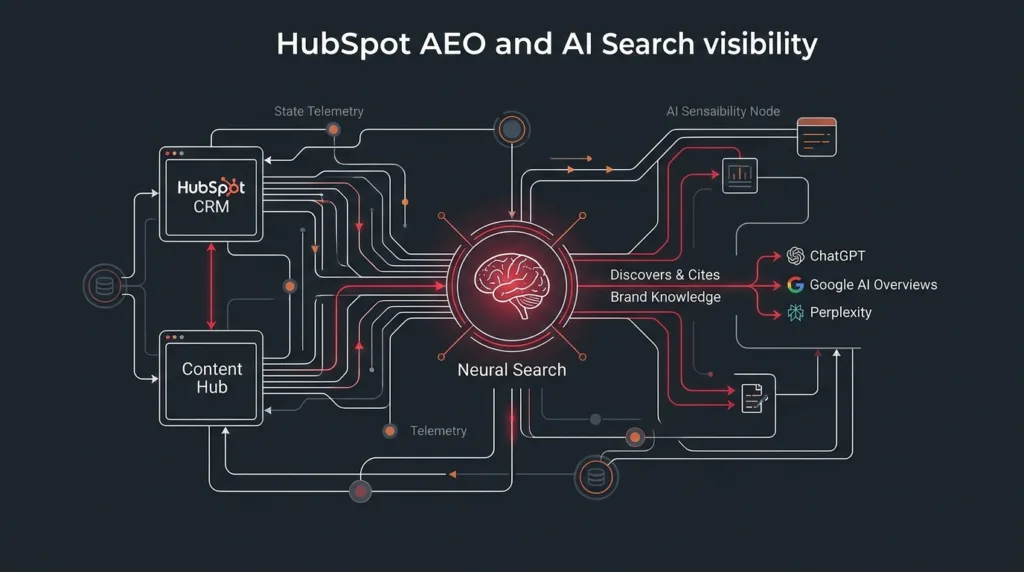
Executive Summary & Market Dynamics
People are increasingly using AI-powered search experiences to research products, compare enterprise vendors, evaluate specialized services, and find answers to mission-critical business questions. Instead of visiting several websites and manually comparing every search result, buyers ask ChatGPT, Google AI Overviews, Gemini, and Perplexity to synthesize available web documentation and recommend suitable solutions.
This shift creates a fundamental challenge for growth leaders and technical marketers: how can your business become an authoritative source that AI search systems discover, understand, mention, and cite? This comprehensive architectural guide details how to implement Answer Engine Optimization (AEO) within your HubSpot CRM and Content Hub ecosystem, complete with technical checklists, schema guidelines, prompt frameworks, and 90-day implementation milestones.
1. What Is HubSpot AEO?
HubSpot AEO refers to utilizing Answer Engine Optimization strategies alongside HubSpot’s native and integrated AEO capabilities to improve, track, and attribute a brand’s visibility across AI-generated answers.
Traditional search engine optimization (SEO) focuses heavily on organic keyword rankings, impressions, click-through rates (CTR), and direct website sessions. AEO expands this scope to address how generative models represent your brand:
Discovery & Inclusion
Does ChatGPT or Perplexity recommend our firm when enterprise buyers ask for implementation specialists in our vertical?
Citation Authority
Does Google AI Overviews cite our original engineering schematics, integration benchmarks, and educational whitepapers?
Competitive Positioning
Which industry competitors are cited more frequently for high-intent evaluation prompts, and what sources back them?
Pipeline Attribution
Are AI-referred visitors converting into Marketing Qualified Leads (MQLs), pipeline opportunities, and closed-won revenue?
HubSpot has deployed dedicated AEO capabilities designed to help marketing teams track brand visibility, analyze citation frequencies, monitor user prompts, benchmark competitors, and identify content optimization opportunities directly within the platform.
Architectural Comparison: Traditional SEO vs. Answer Engine Optimization (AEO)
Strategic Matrix
| Operational Area | Traditional SEO | Answer Engine Optimization (AEO) |
|---|---|---|
| Primary Objective | Maximize organic rankings, impressions, and direct website click-throughs in search engine results pages (SERPs). | Earn inclusion, authoritative mentions, and direct citations inside AI-generated answers and synthesis overviews. |
| Discovery Signals | Keyword density, page metadata, search intent matching, backlink profiles, technical crawlability. | Clear answer-first architecture, structured factual claims, verifiable technical depth, cross-web brand consensus. |
| Typical Measurement | Rank position (1–10), organic traffic sessions, bounce rate, organic goal completions. | Prompt visibility rate, citation frequency, share of AI model voice, AI referral traffic, CRM pipeline attribution. |
| Content Strategy | Long-form exhaustive guides tailored to capture head and long-tail keyword search volumes. | Structured answer modules, verified decision tables, explicit entity definitions, and empirical implementation data. |
| External Presence | High PageRank domain backlinks, guest articles, digital PR outreach. | Authoritative third-party consensus, partner listings, developer documentation, verified review ecosystems. |
| HubSpot Role | CMS page hosting, on-page SEO recommendations, Google Search Console integration. | AI visibility analytics, multi-engine prompt benchmarking, and closed-loop CRM contact attribution. |
2. Understand How AI Search Discovers and Uses Your Content
AI answer engines operate through fundamentally different retrieval mechanisms. While traditional search maps keywords to ranked URLs, Large Language Model (LLM) search engines utilize a combination of Retrieval-Augmented Generation (RAG), real-time web grounding, and parametric memory to synthesize responses.
When a technical leader enters a prompt such as “Which CRM integration consultancy can connect HubSpot with NetSuite?”, the retrieval engine queries current web indices, extracts high-relevance semantic chunks, validates source credibility, and compiles an answer citing the most verifiable sources.
The 6 Foundational Criteria for AI Content Discoverability
Unrestricted Web Accessibility
Pages must be cleanly discoverable, crawlable, and indexable without blocking standard search or AI retrieval user-agents.
Explicit Capability Definitions
Your website must unambiguously state what your firm builds, which systems you integrate, and who your solutions serve.
Answer-First Information Delivery
The primary answer must sit at the top of the content block rather than buried under verbose historical marketing introductions.
Empirical Technical Data
Include real data mappings, webhook limits, field sync rules, and error-handling steps that differentiate expertise from generic summaries.
Contextual Entity Distinction
Establish clear semantic boundaries between your services, software products, and certified technology partner ecosystems.
Verifiable Cross-Web Consensus
Brand claims must align with external directories, partner certifications, technical documentation, and customer reviews.
3. Step One: Establish Your Current AI Visibility
Before rewriting pages or publishing new content, establish a disciplined baseline. Without baseline tracking, you cannot verify whether your optimizations are generating real brand equity or merely increasing content volume.
Developing Your Initial 15–30 Prompt Corpus
Compile a prompt list reflecting how prospective enterprise clients actually query AI systems. For a CRM consulting and integrations practice, sample target prompts include:
- Which specialized consulting firms provide enterprise HubSpot implementation services?
- How can an organization integrate HubSpot Marketing Hub with NetSuite ERP?
- What is the recommended architectural pattern for bidirectional Salesforce and HubSpot synchronization?
- How do you configure dynamic, eligibility-based automated lead routing inside HubSpot?
- What are the primary operational risks when migrating from legacy CRM systems to HubSpot?
- Which iPaaS solution is best suited for real-time CRM and ERP event streaming?
Illustrative AEO Baseline Tracking Sheet
| Tracked Prompt | Engine | Brand Mentioned? | Website Cited? | Competitors Named | Actionable Notes |
|---|---|---|---|---|---|
| HubSpot integration services | ChatGPT (Search) | Record result (Yes/No) | Record citation URL | Log named competitors | Review summary positioning |
| NetSuite CRM integration consultancy | Google Gemini | Record result (Yes/No) | Record citation URL | Log named competitors | Check if case studies are referenced |
| HubSpot lead routing automation rules | Perplexity AI | Record result (Yes/No) | Record citation URL | Log named competitors | Audit cited schema & docs |
*Note: AI outputs vary dynamically between queries. Repeat prompt testing across multiple intervals to establish an accurate statistical baseline.
4. Step Two: Build a Prompt Strategy Around Customer Intent
A common pitfall in generative search optimization is targeting vague high-volume terms such as “CRM”, “AI”, or “HubSpot”. AI-driven discovery begins with specific friction points, comparative trade-offs, and implementation evaluations.
Informational Prompts
Users seeking conceptual architecture and operational definitions.
- What is HubSpot workflow automation?
- How does CRM-to-ERP middleware integration work?
- What is the architectural difference between direct APIs and an iPaaS?
Problem-Solving Prompts
Users attempting to resolve operational failure modes or sync errors.
- How to prevent contact duplicates between HubSpot and Salesforce?
- How to route inbound enterprise leads based on region and ARR eligibility?
- How to troubleshoot failed NetSuite webhook synchronization in HubSpot?
Comparison Prompts
Technical decision-makers evaluating platforms and approaches.
- Boomi vs. Celigo vs. Custom API for NetSuite-HubSpot integration?
- HubSpot CRM vs. Salesforce for mid-market industrial manufacturing?
- Native connectors vs. custom middleware: architectural trade-offs?
Commercial Provider Prompts
Enterprise buyers actively seeking an implementation partner.
- Which consultancies specialize in HubSpot enterprise CRM implementation?
- Who are certified partners for NetSuite and HubSpot ERP integration?
- What qualifications should I look for in a B2B CRM integration consultant?
Prompt Intent to Target Content Architecture Mapping
| User Intent | Recommended Website Asset | Key Architectural Requirements |
|---|---|---|
| Learn a core concept | Comprehensive Technical Guide / Insights Article | Definitive answers, system topology diagram, glossary definitions |
| Resolve an operational issue | In-Depth Tutorial / Engineering Playbook | Step-by-step procedures, code snippets, troubleshooting matrices |
| Compare enterprise solutions | Objective Platform Comparison Breakdown | Feature comparison tables, cost matrices, technical trade-offs |
| Evaluate an implementation provider | Service Capability Page / Empirical Case Study | Proven outcomes, client architectures, certified credentials |
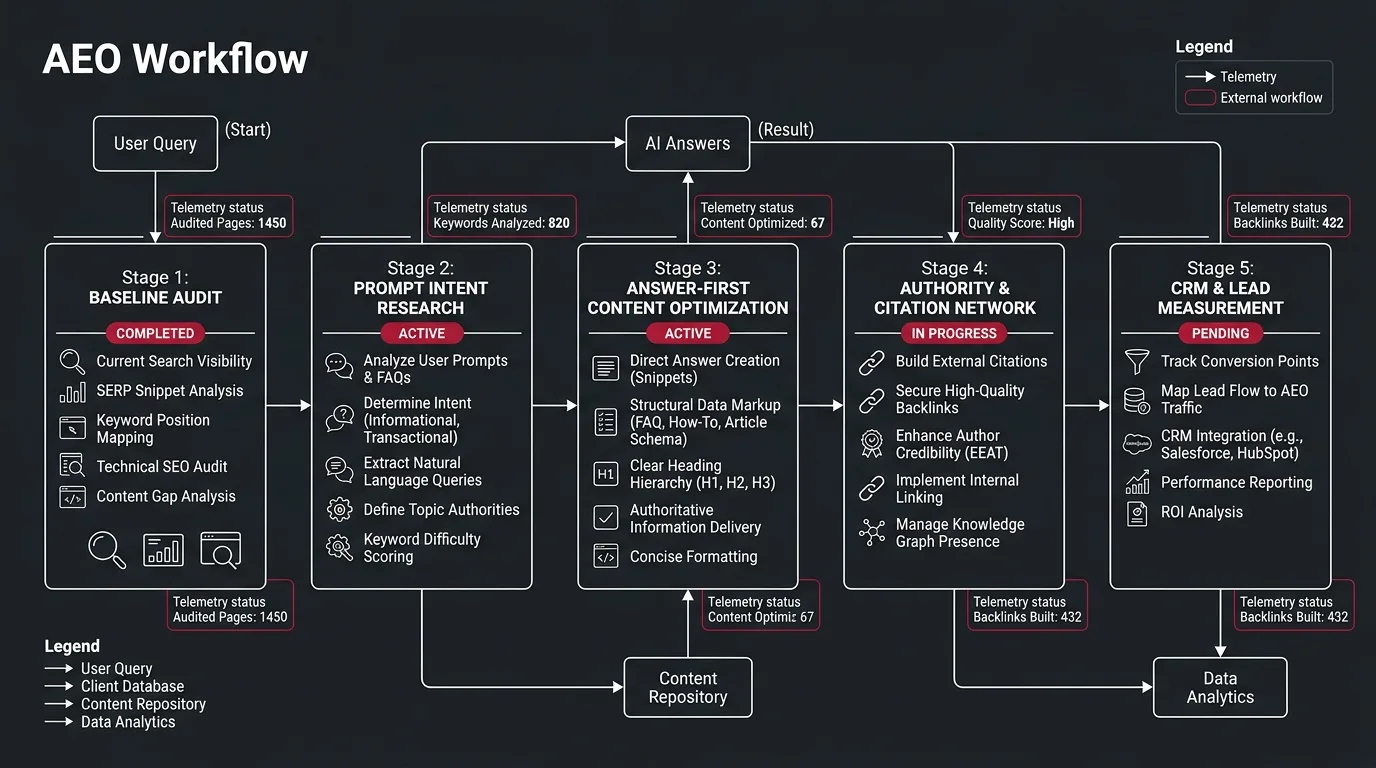
Figure 1.0: End-to-End AEO Implementation Pipeline
Continuous Optimization Loop
5. Step Three: Optimize Your Existing Website Pages
Before creating dozens of new articles, audit and optimize the high-value pages your website already hosts. Focus on core service pages, integration hubs, and customer case studies.
A. Make Your Value Proposition Unambiguous
Within 3 seconds of parsing a page, both human readers and search crawlers must understand: What does this company do? Which vertical do they serve? Which platforms do they integrate?
“Transform your digital future with frictionless next-generation intelligence.”
Fails to communicate specific software platforms, services, or technical capabilities to AI models.
“HubSpot CRM & NetSuite ERP Integration Services for Mid-Market B2B Enterprises.”
Provides explicit entity relationships, software names, and target customer scope.
B. Deliver the Primary Answer at the Top (Inverted Pyramid)
If an article targets “How to integrate HubSpot with NetSuite”, provide the direct architectural answer within the opening two paragraphs. Detail the supported middleware, authentication protocols, and sync direction immediately before diving into historical context.
C. Implement Semantic, Descriptive Headings
Structure content with clear, self-contained H2 and H3 headings. AI retrieval chunks parse subheadings to determine relevance. Replace clever wordplay with descriptive technical headers:
Handling Duplicate Customer IDs
Real-Time vs. Batch API Limits
D. Embed Empirical Implementation Experience
Generic definitions are commoditized. AI search systems prioritize authentic firsthand experience. Include concrete implementation parameters: field mapping schemas, webhook error handling logic, and verified business outcomes.
6. Step Four: Write Content That Answers Questions Clearly
AEO-optimized prose must be clear, accurate, and structured for both human engineers and generative models. Do not artificially truncate complex technical guides into shallow soundbites.
“A HubSpot-to-Salesforce integration synchronizes lead, contact, account, and deal records through the native bi-directional connector, custom REST middleware, or an iPaaS. An effective implementation requires establishing field mappings, deduplication logic, inclusion lists, sync direction rules, and asynchronous error alerting prior to production activation.”
The opening answer directly satisfies the query. Subsequent subsections unpack each requirement (mapping matrices, OAuth configurations, error recovery) systematically.
A Repeatable 10-Point Technical Article Template
7. Step Five: Strengthen Expertise and Brand Information
Generative models evaluate web-wide consensus to determine whether a brand is trustworthy enough to cite. If your website claims expertise that is absent from third-party ecosystems, AI retrieval systems will hesitate to recommend your brand.
Entity Uniformity
Maintain identical corporate name, address, executive bios, and service categories across HubSpot partner listings, LinkedIn, Crunchbase, and GitHub.
Authoritative Citations
Contribute technical architecture analyses to industry publications, speak at developer conferences, and build verified directory citations.
Empirical Evidence
Ground all published case studies in verifiable metrics (e.g., sync latency, lead volume, data accuracy). Never invent synthetic quotes or fabricated metrics.
8. Step Six: Improve Technical SEO and Crawlability
Even the most insightful technical prose cannot earn AI citations if search spiders cannot discover, crawl, render, and index your pages cleanly. Technical SEO is the bedrock of AEO.
10-Point Technical Crawlability & AEO Checklist
9. Step Seven: Use Structured Data Correctly
Structured data (Schema.org JSON-LD) provides search engines with explicit semantic context regarding the entities, authors, organizations, and technical specifications present on your page.
Recommended Schema Types
- Organization: Legal name, logo, official URLs, SameAs social links.
- Article / BlogPosting: Author identity, datePublished, dateModified, headline.
- BreadcrumbList: Explicit category hierarchy and site taxonomy.
- Service / ProfessionalService: Scope of consulting and integration offerings.
Myths & Misconceptions
- No “AI Overview Schema”: There is no proprietary schema tag that guarantees placement in Google AI Overviews.
- llms.txt is Optional: Google explicitly states that creating an
llms.txtfile is not required for AI search inclusion. - Avoid Hidden FAQ Spam: Do not mark up FAQs that are invisible to real human users.
10. Step Eight: Use Images, Diagrams, and Video Strategically
AEO is multimodal. Generative search engines evaluate technical diagrams, process schematics, and embedded video transcripts to extract structured context and assess page quality.
Figure 2.0: HubSpot-to-Salesforce Bi-Directional Integration Architecture
Bi-Directional Event Fabric
hub
HubSpot Marketing
Contact Lifecycle • MQL Activity • Attribution Touchpoints
Deduplication & Field Mapping
cloud_sync
Salesforce CRM
Leads • Accounts • Opportunities • Closed-Won Revenue
Multi-Modal Asset Optimization Checklist
- Descriptive Technical Filenames: Use
hubspot-salesforce-integration-flow.webpinstead ofscreenshot-102.png. - Informative Semantic Alt Text: Describe exact data flow paths rather than stuffing keywords.
- Modern Formats & Compression: Serve WebP or AVIF with explicit width and height dimensions to prevent cumulative layout shift (CLS).
- Comprehensive Text Pairing: Never lock critical numbers, field names, or procedures exclusively inside an image without accompanying plain-text documentation.
11. Step Nine: Measure AEO Performance in HubSpot
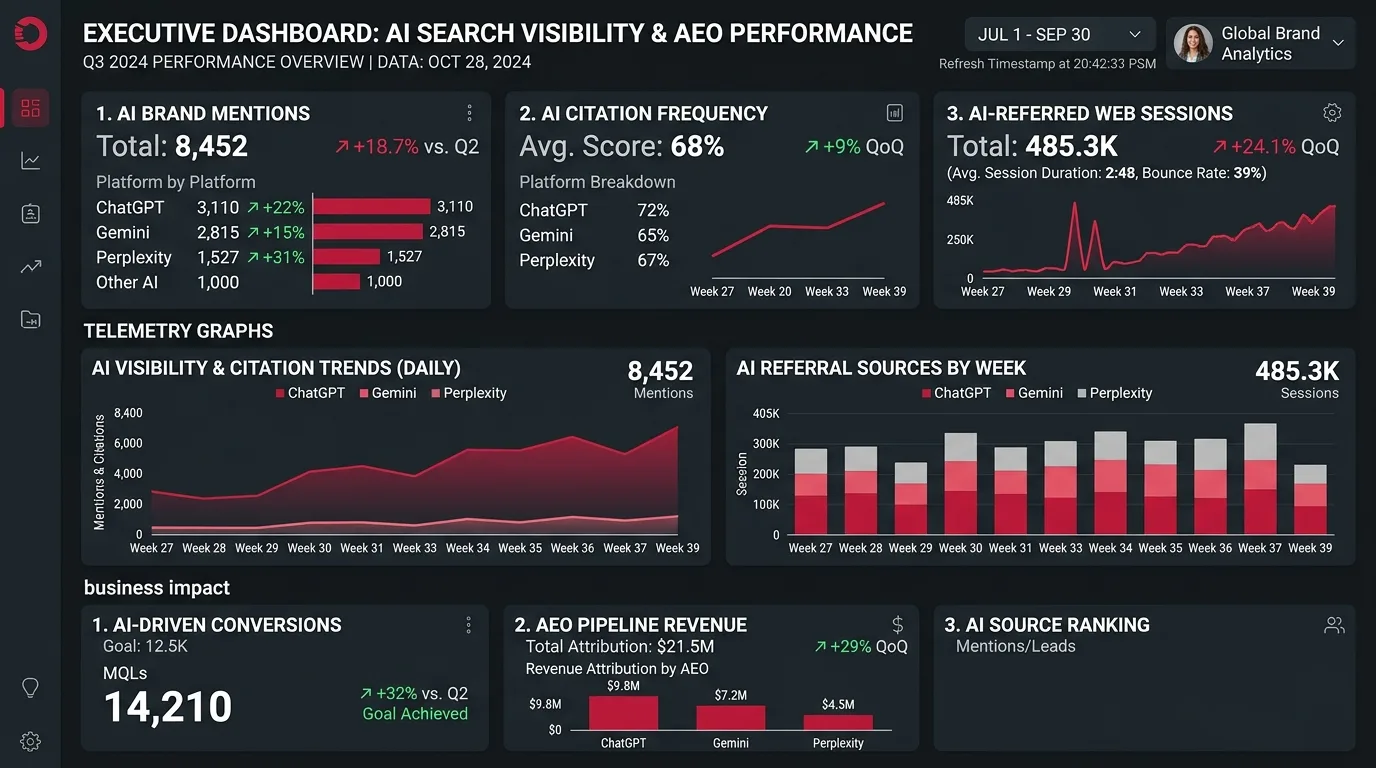
Measuring AEO requires tracking brand visibility across AI models, analyzing citation sources, and connecting AI referrals to real CRM pipeline outcomes.
Figure 3.0: Executive AI Visibility & HubSpot Attribution Dashboard
Attribution Telemetry
The 7 Core AEO Performance Metrics
| Metric | Strategic Value | Measurement Source |
|---|---|---|
| Prompt Visibility Rate | Percentage of tracked buyer prompts in which your brand is named or recommended. | HubSpot AEO / Manual Tracking |
| Citation Coverage | Frequency with which your domain is hyperlinked as an authoritative source. | Perplexity / AI Overviews / Search Console |
| Share of Model Voice | Ratio of brand mentions compared directly to targeted market competitors. | HubSpot Competitive AEO |
| AI-Referred Sessions | Web traffic originating from ChatGPT, Perplexity, Claude, and Gemini referral sources. | HubSpot Traffic Analytics / GA4 |
| AI-Referred Conversions | Form fills, meeting bookings, and inquiry submissions from AI visitors. | HubSpot Forms & Landing Pages |
| Qualified Opportunities | Sales Pipeline deals created from contacts with AI referral touchpoints. | HubSpot Deals & Lifecycle Stages |
| Closed-Won Revenue | Actual contract value attributed through multi-touch CRM attribution models. | HubSpot Revenue Attribution |
12. Step Ten: Build an AEO Content Refresh Process
Answer engines prioritize fresh, verified information. AEO is not a static one-time overhaul; it demands a scheduled quarterly audit cadence.
Quarterly AEO Review Protocol
-
sync_problem
Identify Legacy Organic Articles Lacking AI Visibility: Pinpoint pages receiving traditional search visits that fail to trigger citations in answer engines. Restructure with direct answers. -
trending_up
Analyze Competitor Citation Shifts: Review prompts where competing consultancies have displaced your brand, and evaluate their supporting external citations. -
verified
Audit Deprecated Software APIs & Specs: Remove outdated CRM field limits, update webhook endpoints, and ensure technical documentation matches vendor updates. -
contact_support
Surface High-Value Unanswered Buyer Prompts: Analyze inbound sales inquiries to identify new architectural questions currently unaddressed on your site.
13. Things to Do and Things Not to Do in HubSpot AEO
Best Practices (Do)
- ✔ Publish answer-first content that directly addresses high-intent business problems.
- ✔ Keep all technical specifications current, linking out to official vendor documentation.
- ✔ Ensure complete crawler accessibility across both standard and AI search bots.
- ✔ Clearly define company services, supported platforms, and project deliverables.
- ✔ Incorporate original architecture diagrams, data flowcharts, and configuration screenshots.
- ✔ Implement valid JSON-LD schema that accurately reflects the visible page.
- ✔ Earn authentic third-party citations and industry directory references.
- ✔ Connect AI referral metrics directly to HubSpot CRM deals and revenue pipeline.
Failure Modes (Don’t)
- ✖ Do not stuff pages with repeated buzzwords like “HubSpot AEO” or “AI SEO.”
- ✖ Do not mass-publish hundreds of synthetic, unedited AI-generated blog posts.
- ✖ Do not fabricate client quotes, integration benchmarks, or partnership certifications.
- ✖ Do not attempt to purchase artificial brand mentions to manipulate model answers.
- ✖ Do not assume schema markup guarantees inclusion in Google AI Overviews.
- ✖ Do not rely on llms.txt as a shortcut to bypass standard technical SEO.
- ✖ Do not hide essential information inside inaccessible client-side JavaScript.
- ✖ Do not assume a single query test represents consistent multi-engine visibility.
14. A Practical 90-Day HubSpot AEO Plan
Transforming your website into a trusted, cited source in AI search is an iterative discipline. Execute this structured 90-day quarterly roadmap to achieve measurable results.
Audit & Baseline
Establish Baseline Visibility & Technical Health
- Identify priority CRM, integration, and automation services to target.
- Formulate your core corpus of 15–30 buyer evaluation prompts.
- Record initial visibility rates, citations, and named competitors across ChatGPT, Gemini, and Perplexity.
- Audit robots.txt, XML sitemaps, canonical tags, and internal link equity.
- Select the 5–10 highest-value website pages responsible for lead generation.
Content & Media
Restructure Content & Deploy Multimodal Assets
- Rewrite priority service pages using the answer-first structural blueprint.
- Eliminate generic marketing prose and clearly state platforms, methods, and outcomes.
- Produce original architecture diagrams and data flow schematics with WebP optimization.
- Validate JSON-LD Article and Organization schema markup via Google Rich Results Test.
- Configure HubSpot traffic source tracking and custom UTM parameters for AI referral channels.
Measurement & Refinement
Measure Attribution & Establish Cadenced Review
- Re-run the 15–30 prompt corpus and evaluate changes in brand inclusion and citation frequency.
- Analyze AI-referred sessions, bounce rates, and form submissions in HubSpot CRM.
- Identify content gaps where competitors continue to earn exclusive citations.
- Publish targeted technical tutorials addressing uncovered high-intent problem prompts.
- Formalize a recurring quarterly review cycle with marketing and sales engineering teams.
15. Frequently Asked Questions About HubSpot AEO
What is HubSpot AEO?
HubSpot AEO is an operational methodology combining Answer Engine Optimization content strategies with HubSpot’s AI search tracking tools. It helps marketing and revenue teams measure brand mentions, analyze citation sources, benchmark competitor presence, and attribute AI-referred visitors across the CRM sales pipeline.
How do I get my website cited in ChatGPT search results?
Publish accurate, verifiable, answer-first content addressing specific buyer problems. Ensure your website maintains strong technical SEO (clean crawlability, fast load speeds, valid schema), and build authentic cross-web consensus through partner directories, technical case studies, and third-party references. No single shortcut guarantees inclusion.
How is AEO different from traditional SEO?
While traditional SEO focuses on SERP rankings (positions 1–10) and organic page impressions, AEO optimizes for brand inclusion, factual synthesis, and citations inside generated answers from systems like Perplexity, Gemini, and ChatGPT. Both share foundational requirements: crawlable code, fast loading, and authoritative content.
Does HubSpot AEO automatically optimize my web pages?
No. HubSpot’s AEO tools provide visibility telemetry, prompt monitoring, and competitive benchmarks. Engineering and marketing teams must analyze the diagnostic data, rewrite page architectures, produce original technical assets, and refine the site’s underlying information design.
Is an llms.txt file required for AI search visibility?
No. Google has officially stated that it does not require or evaluate llms.txt files for its generative AI search features (including AI Overviews). While you may choose to maintain one for open-source LLM context scraping, it is not a substitute for rigorous technical SEO and high-quality web documentation.
Does FAQ schema guarantee inclusion in AI Overviews?
No. Schema.org structured data helps crawlers understand page semantics, but does not guarantee citation in AI answers. Use FAQ schema only when questions and answers are plainly visible and useful to human site visitors.
How long does it take to see measurable AEO results?
Timelines typically span 60 to 90 days. Because AI search engines combine live retrieval with model grounding and web-wide authority signals, pages must be crawled, indexed, and recognized as credible sources across multiple evaluation cycles before citations stabilize.
Can HubSpot track leads and revenue generated from AI search engines?
Yes. By monitoring AI referral sources (such as chatgpt.com, perplexity.ai, and gemini.google.com) within HubSpot Traffic Analytics, you can associate incoming visitor sessions with contact creation, lifecycle stage progression, sales opportunities, and closed-won revenue attribution.
Conclusion: Make Your Business an Authoritative Source for AI Search
Optimizing HubSpot AEO is not about discovering an ephemeral hack to manipulate generative search models. It is about establishing your company as an indisputable, technically verifiable authority in your market.
By benchmarking your baseline visibility, organizing content around authentic buyer intent, delivering answer-first technical prose, maintaining impeccable technical SEO, and leveraging HubSpot CRM to connect model citations with closed pipeline, you build a resilient, long-term search presence that compounds over time.
Consulting & Technical Execution
Need Help Architecting Your HubSpot & AI Search Strategy?
iDesk Media assists growing enterprises with comprehensive HubSpot environment optimization, advanced CRM consulting, workflow automation, custom ERP integrations, technical SEO audits, and connected revenue operations. If you are ready to audit your search architecture, structure content around high-intent buyer prompts, or connect AI referrals directly with your CRM revenue pipeline, our engineering team is here to help.
Schedule an Architecture Consultation
arrow_forward
Zero obligation • Response within 24 business hours