
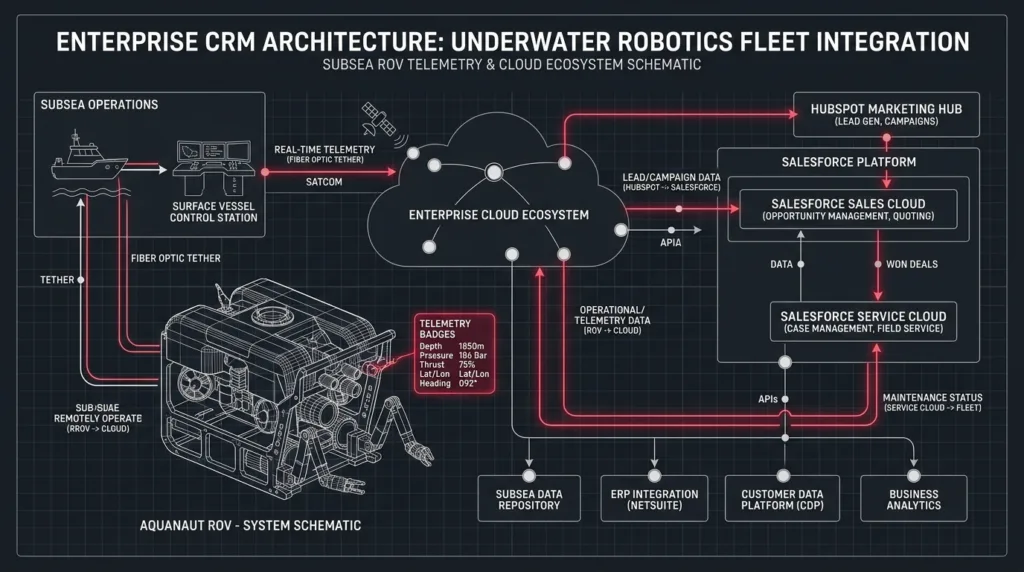
Operating in the high-stakes subsea technology sector, an enterprise manufacturer of deep-sea Remotely Operated Vehicles (ROVs) faced operational friction between top-of-funnel marketing engagement and complex, long-cycle capital sales execution. Here is how iDesk Media architected and deployed a bi-directional integration connecting HubSpot Marketing & Sales Hub with Salesforce Sales Cloud and Service Cloud, incorporating custom conditional workflows, multi-tiered property groups, and robust role-based access governance.
System Architecture Specifications
Underwater Robotics & Subsea Technology
B2B Enterprise Equipment Manufacturer
United States (Global Operations)
Salesforce Sales/Service • HubSpot Hubs
1. Project Overview & Operational Context
A US-based enterprise specializing in specialized underwater remotely operated vehicles (ROVs) and subsea robotic systems required an integrated CRM environment to scale its global commercial operations. The enterprise manufactures modular underwater robotic platforms utilized in commercial offshore energy, oceanographic scientific research, defense inspection, and maritime infrastructure maintenance.
The business utilized HubSpot as its inbound marketing automation platform and Salesforce as its core transactional environment for pipeline management, quote generation, and post-sale technical field service. Connecting these systems was essential to ensuring that marketing-generated leads transitioned seamlessly to direct sales engineers, while critical opportunity milestones, customer health indicators, and field service updates synchronized back to HubSpot for lifecycle marketing visibility.
iDesk Media supported the Salesforce Sales Cloud and Service Cloud environment, configured advanced conditional workflows and property structures, structured user security and access profiles, and engineered an enterprise bi-directional integration between HubSpot and Salesforce.
2. The Business Challenge: Disconnected Lifecycle Data & Multi-Team Friction
Enterprises selling specialized underwater robotic systems operate across complex, multi-stakeholder B2B buying journeys. Capital equipment purchase cycles frequently extend over 6 to 18 months, requiring rigorous technical discovery, custom payload integration assessments, security reviews, and ongoing post-sale support.
Prior to this implementation, HubSpot and Salesforce functioned as disconnected operational islands. While each platform performed well in its dedicated domain, the absence of an automated synchronization bridge created significant friction across the customer lifecycle:
Marketing-to-Sales Handoff Delays
Inbound engineering inquiries, technical whitepaper downloads, and event leads generated in HubSpot had to be manually triaged and re-entered into Salesforce. High-intent opportunities suffered response latency, creating risk in competitive bid processes.
Downstream Blind Spots in Marketing
Marketing teams possessed zero automated visibility into whether inbound leads matured into qualified Salesforce Opportunities, stalled in technical reviews, or closed. Closed-loop attribution was impossible to calculate accurately.
Generic, Uncalibrated Automations
Previous automations treated all prospect records uniformly, failing to differentiate between commercial offshore oil & gas contractors, university research institutes, and naval defense agencies that possess radically distinct procurement protocols.
Access Governance & Schema Entropy
Without structured property groups and field-level security, users had uncurated access to hundreds of unorganized fields. Data drift, duplicate entries, and inconsistent property tagging undermined reporting reliability.
Motion Graphic 1.0: Bi-Directional Event Orchestration Bus
HubSpot ↔ Salesforce Integration Pipeline
3. The Architectural Solution: Seven-Pillar Implementation Framework
iDesk Media deployed a comprehensive systems architecture structured across seven functional pillars, resolving cross-platform data drift while respecting the specialized functional roles of each CRM environment:
Salesforce Sales Cloud Configuration
Salesforce Sales Cloud served as the primary operational environment for managing complex sales cycles and capital opportunities. The configuration focused on structuring custom data models and business rules around specialized subsea equipment:
- Robotic Systems Data Models: Engineered custom objects and property groups capturing operational depth ratings (e.g., 1,000m vs. 6,000m), umbilical tether specifications, manipulator arm configurations, and payload sensor suites.
- Multi-Stage Deal Governance: Structured disciplined B2B pipeline stages—ranging from Initial Technical Review and Engineering Feasibility to Formal Proposal, Factory Acceptance Testing (FAT), and Contracting.
- Validation Rules: Enforced mandatory data capture at critical pipeline transitions, preventing opportunities from moving to proposal delivery without verified technical application specs.
Salesforce Service Cloud Alignment
Salesforce Service Cloud was aligned directly alongside Sales Cloud to support mission-critical post-sale robotics operations within the same CRM core:
- Case Management & Support Queues: Structured tiered technical support queues separating critical offshore vessel downtime emergencies from scheduled maintenance and replacement thruster orders.
- Asset & Warranty Tracking: Maintained relational links between customer accounts, deployed ROV system serial numbers, installed firmware revisions, and service warranty agreements.
- Unified Account 360: Enabled sales engineers to immediately view open support tickets and field maintenance records before engaging accounts on fleet upgrades.
HubSpot Sales Hub & Marketing Hub Bi-Directional Integration
Rather than migrating users out of HubSpot, the organization preserved HubSpot for its core strengths—content delivery, lead nurturing, and marketing intelligence—while connecting it directly to Salesforce:
Leads generated through technical webinars, CAD file downloads, and consultation requests flow immediately into Salesforce. Integration logic maps contact properties, assigns lead scoring indicators, and checks for existing corporate accounts to prevent duplicate creation.
Crucial sales milestones (e.g., Lead Status, Opportunity Stage, Contract Value, Deal Owner, Closed-Won Date) and Service Cloud status indicators synchronize continuously back to corresponding HubSpot contact and company records, powering segmented lifecycle nurturing.
Conditional Workflows & Property Architecture
To avoid rigid, monolithic automation rules, iDesk Media configured dynamic conditional logic across both platforms. Workflows evaluate multi-variable parameters—including industry sector (Offshore Energy vs. Scientific Research vs. Defense), purchasing timeframe, and required vehicle depth—to route records and trigger conditional tasks.
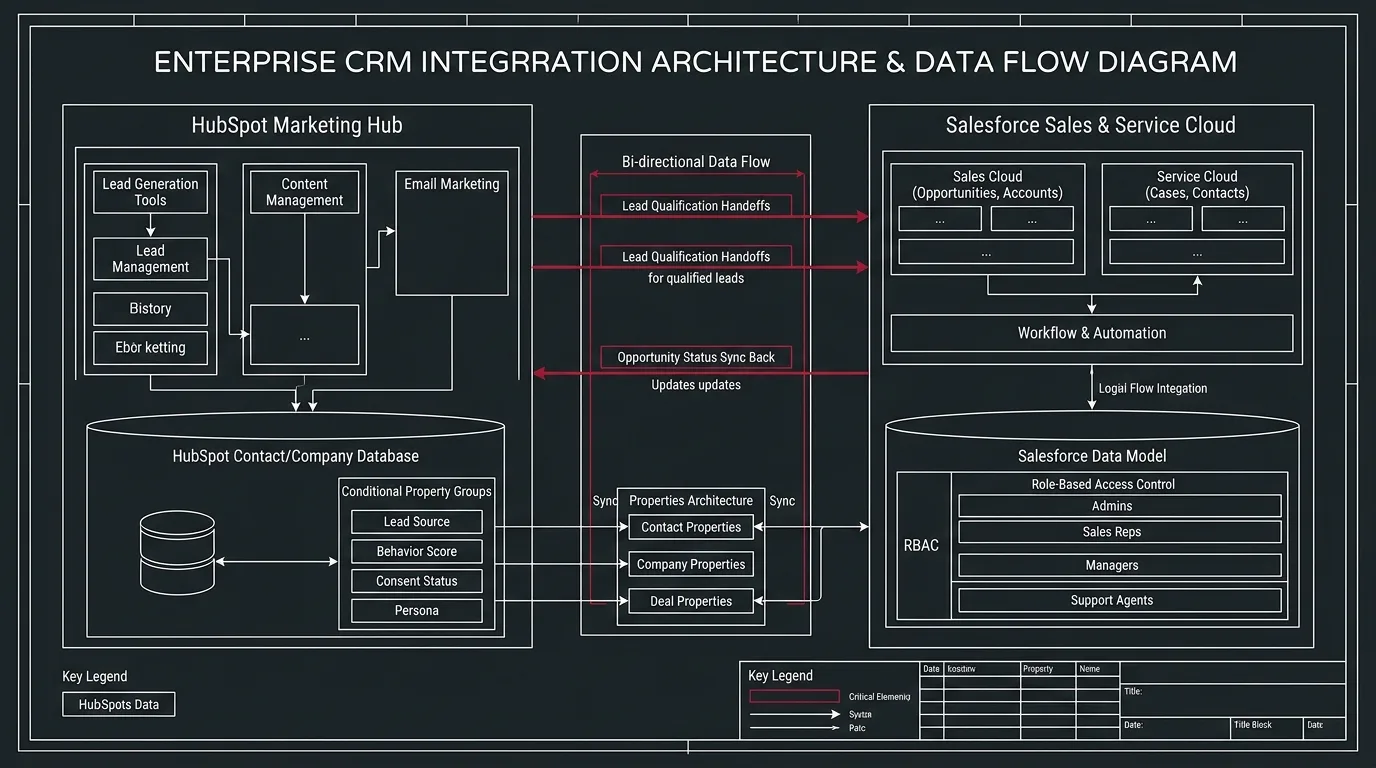
In tandem, a structured property architecture organized CRM information into logical groups:
- Robotics Technical Specifications: Operational depth, sensor payloads, tooling options, propulsion power.
- Commercial & Procurement Terms: Funding cycle, bid deadline, commercial terms, export control compliance (ITAR/EAR).
- Operational Deployment Details: Vessel name, port of mobilization, offshore operating location.
User & Access Governance
Custom Salesforce profiles, permission sets, and HubSpot role-based permissions were established to guarantee principle-of-least-privilege access. Sales engineers access technical opportunities without altering global marketing forms; support specialists manage Service Cloud cases without altering financial quote templates; and executives view consolidated pipeline reports.
Integration Administration & Hygiene
Continuous monitoring protocols, sync health dashboards, and automated error logging alert administrators to sync collisions or unmapped field anomalies. Bidirectional rules enforce deterministic data ownership, preventing race conditions or infinite webhook feedback loops between platforms.
4. Integration Architecture Data Flow Map
The deployed CRM integration connects two primary enterprise environments while maintaining strict boundaries of authority across each record type:
| Record / Data Entity | Master Authoritative System | Synchronization Direction | Operational Purpose |
|---|---|---|---|
| Prospects & Inbound Leads | HubSpot Marketing Hub | HubSpot → Salesforce | Capture website inquiries, event leads, and content downloads |
| Account & Corporate Entities | Salesforce Sales Cloud | Salesforce ↔ HubSpot | Parent-child account hierarchies, billing entities, credit terms |
| Robotics Opportunities & Quotes | Salesforce Sales Cloud | Salesforce → HubSpot | Deal stage, proposal values, expected delivery dates |
| Service Tickets & RMA Cases | Salesforce Service Cloud | Salesforce → HubSpot | Customer support health scores, field service case alerts |
| Email Engagement & Web Activity | HubSpot Marketing Hub | HubSpot → Salesforce | Lead timeline activity embedded into Salesforce Lead/Contact pages |
5. Verified Business Deliverables & Architectural Value
The completed implementation delivered an interconnected digital operations framework designed to support cross-departmental collaboration across marketing, sales engineering, and customer support. Verified architectural deliverables include:
Lead-to-Opportunity Continuity
Eliminated manual lead entry, connecting marketing capture directly to sales execution.
Real-Time Data Alignment
Downstream deal updates and service metrics sync automatically to HubSpot marketing contacts.
Specialized ROV Schemas
Standardized vehicle specifications, deployment depths, and payload configurations across teams.
Strict Security Profiles
Clear access controls tailored to sales, support, and marketing responsibilities.
*In accordance with enterprise confidentiality standards, specific percentage improvements and proprietary financial figures are excluded; verified deliverables reflect production architecture and functional integration milestones.
6. Why CRM Integration Matters for Enterprise Technology Companies
Enterprises manufacturing specialized capital equipment—from subsea robotics and industrial automation to aerospace components—manage high-ticket purchase journeys with complex technical specifications and distributed buying committees.
When marketing and sales systems operate in silos, high-value technical opportunities fall through the cracks, sales teams lack context on digital research behavior, and marketing teams allocate budget blindly without revenue feedback.
By integrating HubSpot with Salesforce Sales and Service Cloud, organizations unite demand generation with operational sales execution and post-sale technical support into a single, cohesive customer relationship continuum.
Planning a Salesforce & HubSpot Integration?
Schedule an architectural consultation with our senior systems engineering practice.